Dear brothers and sisters,
Blessed Holy Week!
Although Holy Week follows the same pattern each year, it never becomes repetitive. The Church offers us a rich program of services, and as we move toward the second half of the week we begin to relive the actual events in Jerusalem: the Mystical Supper, the betrayal, the arrest, the trial, Golgotha, the burial, and finally the empty tomb.
The first days, however, are more reflective. The Gospel readings of the Bridegroom Orthroses, celebrated by anticipation on the evening of the preceding day, together with the Liturgies of the Presanctified Gifts, contain long discourses of Christ with His disciples and others. Through parables and vivid images, they speak directly about our spiritual life and prepare us inwardly for the Passion.
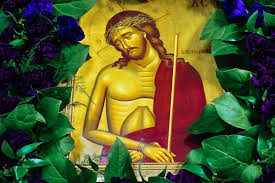
The Bridegroom Orthroses themselves, as the name suggests, draw on the image of the Bridegroom from the parable of the ten virgins (Matthew 25:1–13). This image calls us to readiness, since no one knows the hour when God will come to call us. When that moment arrives, it will be too late to fill our lamps with the oil of virtues, and we cannot borrow it from others. We are called to vigilance, to follow Christ without falling, especially as we claim to walk with Him on this path to the Cross.
Troparion of the Bridegroom in Tone Eight:
Behold, the Bridegroom cometh in the middle of the night, and blessed is that servant whom He shall find watching; and again unworthy is he whom He shall find heedless. Beware, therefore, O my soul, lest thou be borne down with sleep, lest thou be given up to death, and be shut out from the Kingdom. But rather rouse thyself and cry: Holy, Holy, Holy art Thou, O our God.
-English: https://www.youtube.com/watch?v=pbEjqw4qhZ8
– Arabic: https://www.youtube.com/watch?v=wKRcZRpHGAo
The Gospel readings continue this call. On Holy Monday we hear the story of Christ cursing the barren fig tree (Matthew 21:18–22), and the parables of the Two Sons (Matthew 21:28–32), the Wicked Husbandmen (Matthew 21:33–46). Together these warn us against spiritual barrenness, hypocrisy, and rejecting the invitation of the Kingdom.
On Holy Tuesday the Lord continues to call us to vigilance. We hear His confrontation with the Pharisees and scribes (Matthew 22:15–23:39), warning against hypocrisy, outward religiosity without inner transformation, and the neglect of “the weightier matters of the law: judgment, mercy, and faith.” We also hear His discourse about the last things (Matthew 24:3–35; 24:36–26:2), including the parables of the faithful and evil servant (Matthew 24:45–51), the ten virgins (Matthew 25:1–13), and the talents (Matthew 25:14–30), followed by the description of the Last Judgment (Matthew 25:31–46). Together these readings emphasize vigilance, sincerity, responsibility for the gifts given to us, and love expressed in concrete deeds.
On Holy Wednesday the focus turns to repentance and decision. At the Bridegroom Orthros we hear the Gospel according to John (12:17–50), where Christ speaks about the light and calls people to believe while the light is still with them: “Walk while ye have the light, lest darkness come upon you.” Some believe in Him, others refuse, and we are confronted with the urgency of choosing Christ. The Gospel of the woman who anointed the Lord with myrrh (Matthew 26:6–16), placed in contrast with the betrayal of Judas, presents two responses to Christ: sacrificial love or self-interest — and the Church calls us to follow the path of repentance.
Yet Holy Week teaches us not only through the Gospel readings. The hymns themselves interpret the Gospels and show us how to live them. They open to us what vigilance means in practice and how we are to follow Christ.
They teach us first about love, peace, and humility. The Canon of Holy Monday says:
“All will know that ye are in truth My disciples, if ye shall keep My commandments… have peace among yourselves and peace with all men, be lowly-minded, and ye shall be raised on high.”
Vigilance, therefore, is not anxiety or fear, but a life shaped by peace, humility, and love.
They teach us also detachment from earthly pleasures. The Stichera of the Praises on Holy Monday call us: “Let us go in the way with Him, and let us be crucified with Him, and die for Him to the pleasures of this life, that we may also live with Him.”
To follow Christ toward Golgotha means dying already to the passions that hold us captive.
We are given also the example of chastity and purity in Joseph the Patriarch, in the Aposticha Stichera: “Finding in the Egyptian woman a second Eve, the dragon hastened by words of flattery to make Joseph stumble; but leaving his garment, he fled from sin, and though naked, was unashamed, even as our first parent before his disobedience. By his supplications, O Christ, have mercy on us”
Joseph fled from sin, leaving his garment behind, and remained unashamed. He becomes an image of vigilance, not negotiating with temptation, but fleeing from it.
The hymns of Holy Tuesday continue this teaching by focusing on the parable of the talents. The Canon exhorts: “Let every one of you that received a talent from the hand of God increase it in measure.”
Repentance is therefore not only sorrow for sin, but filling the void left by sin with good works, with active faith and service.
The Aposticha of Holy Tuesday make this even more concrete:
“Come, O ye faithful, let us labor earnestly for the Master, for He distributeth riches to His servants. Let us each, according to measure, increase the talent of grace many times over. Let one acquire wisdom through good works; let another render the service of generosity; let the believer communicate the word to the uninitiated and let another disperse his riches to the poor; for so shall we increase the loan many times over, and as faithful stewards of that grace, we shall be deemed worthy of the joy of the Master. Count us worthy of this, O Christ God, since Thou art the Friend of man“
One should acquire wisdom through good works; another practice generosity; another teach the ignorant; another give to the poor. Vigilance is not passive waiting, but labor, using the gifts God has given us in service to others.
Thus, before we stand at Golgotha and before we witness the empty tomb of the Resurrected Lord, the Church first teaches us how to prepare: to be watchful, to bear spiritual fruit, to multiply the talents entrusted to us, to live in peace and humility, to detach ourselves from earthly passions, and to follow Christ in purity and love. Only then are we ready to walk with Him to the Cross and to receive the joy of the Resurrection.
Even though we are not able to gather for these services at the beginning of the week, the Church still guides us through these days of preparation, so that when we meet later in the week we are ready to walk together with Christ to His Passion and Resurrection.
If you are able, I encourage you to follow the live broadcasts of the Bridegroom Orthroses on Monday and Tuesday at 7:00 PM from the Cathedral: https://www.facebook.com/StGeorgeOrthodoxAntiochianOfLondon
Yours in Christ,
Fr Dmitry