Beloved brothers and sisters,
Christ is Risen! Tá Críost éirithe! Χριστὸς ἀνέστη! المسيح قام! Христос Воскресе!
This is Community Bulletin #38 of Saint Ignatius Parish in Belfast
Contents of this Bulletin:
- This Week in the Life of the Church: Myrrh-Bearing Women
- A Pastoral Word: Faithfulness is Love in Action
- News and Announcements: Faith and Fellowship moves back to Wednesdays
This Week in the Life of the Church
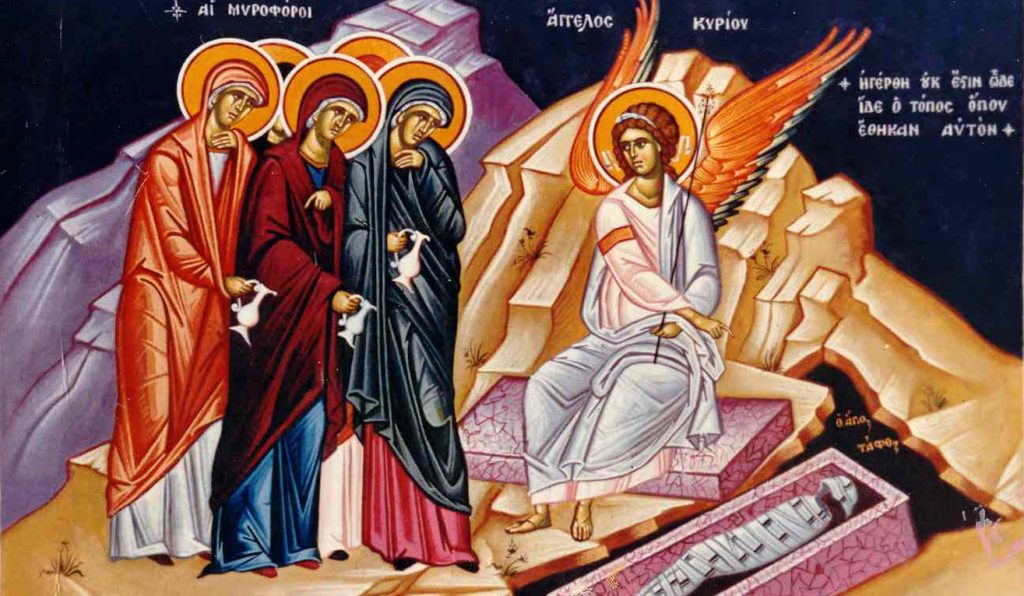
On the Third Sunday of Pascha, we commemorate the Myrrh-Bearers. These are women who followed Christ during His earthly ministry, who served Him and His disciples, and who came to the tomb to anoint His Body after His death and burial. Instead, they found the tomb empty and were the first to hear from the angel the joyful news of the Resurrection. You can read about them here: https://orthochristian.com/70404.html
This feast has, in practice, become a kind of women’s day in the Orthodox Church, a day on which we celebrate the women of our parishes.
In most parishes, whether there is an organised Ladies’ Group or not, women take upon themselves many ministries. Some are more visible than others. Many ladies chant. Yet many more quietly serve in ways that often go unnoticed, looking after the church, decorating it with flowers, making vestments, preparing food for parish meals, organising social activities, and serving as treasurers, parish council members, trustees, safeguarding officers, and in many other roles.
Quite often, this is a silent ministry, hidden from the eyes of many, yet essential for the life of a well functioning church community, much like the ministry of the Myrrh Bearing Women.
Wishing all the ladies of our parish happy feast and many years! May the Myrrh Bearers be an inspiration in your service to the Church, and support your ministry through their intercessions.
Saints and Feasts of the Week
*The saints named here accompany the days of the week as living witnesses of Christ. Only the principal saint or feast of each day is listed here, in keeping with the liturgical order of the Church.
- Sunday, 26th of April – Sunday of the Myrrh-Bearing Women
- Monday, 27th of April – The Holy Hieromartyr Symeon, Kinsman of the Lord
- Tuesday, 28th of April – Nine Martyrs of Cyzicus: Theognes, Rufus, Antipater, Theostichus, Artemas, Magnus, Theodotus, Thaumasius, and Philemon
- Wednesday, 29th of April – Jason and Sosipater the Apostles of the 70 and their Companions
- Thursday, 30th of April – Holy Apostle James the son of Zebedee, brother of Saint John the Theologian
- Friday, 1st of May – Righteous Prophet Jeremiah
- Saturday, 2nd of May – Translation of the relics of Saint Athanasius the Great, Patriarch of Alexandria
- Sunday, 3rd of May – Sunday of the Paralytic
Hymns of the Week
*The hymns listed here are those that shape the prayer of the Church for the week, following the liturgical order and hierarchy. They are offered as an aid to prayer and may be used, as each is able, in personal prayer or a simple prayer rule at home.
APOLYTIKION OF PASCHA IN TONE FIVE
Christ is risen from the dead, trampling down death by death; and upon those in the tombs bestowing life (thrice)
*From Pascha Sunday to the Sunday of Pentecost, the prayer “O Heavenly King…” is not said. And from Pascha Sunday to its leave-taking (Wednesday, 20th of May, 39 days after Paschal Sunday), instead of “Holy God,” “O come, let us worship and fall down…” in Orthros, the Hours, and Vespers; and “We have seen the true light” in the Divine Liturgy, we say “Christ is risen.” This also applies to morning and evening prayers, as well as to prayers before meals.
APOLYTIKION OF JOSEPH OF ARIMATHAEA IN TONE TWO
The noble Joseph, taking Thine immaculate Body down from the Tree, and having wrapped It in pure linen and spices, laid It for burial in a new tomb. But on the third day Thou didst arise, O Lord, granting to the world Great Mercy.
APOLYTIKION OF THE MYRRH-BEARING WOMEN IN TONE TWO
Unto the myrrh-bearing women did the Angel cry out as he stood by the grave: Myrrh-oils are meet for the dead, but Christ hath proved to be a stranger to corruption. But cry out: The Lord is risen, granting to the world Great Mercy.
KONTAKION OF PASCHA IN TONE EIGHT
Though Thou didst descend into the grave, O Immortal One, yet didst Thou destroy the power of Hades, and didst arise as victor, O Christ God, calling to the myrrh-bearing women, Rejoice, and giving peace unto Thine Apostles, O Thou Who dost grant resurrection to the fallen.
MEGALYNARION OF PASCHA IN TONE ONE
The Angel cried unto her that is full of grace: O pure Virgin, rejoice, and again I say, rejoice; for thy Son hath arisen from the grave on the third day. Shine, shine, O new Jerusalem, for the glory of the Lord hath arisen upon thee; dance now and beglad, O Zion, and do thou exult, O pure Theotokos, in the arising of Him Whom thou didst bear.
*We say Paschal Megalynarion in place of “It is Truly meet to bless thee” at the conclusion of morning and evening prayers, as well as after the meals.
Sunday Epistle and Gospel
*The Epistle and Gospel of the Sunday that begins the current liturgical week
- Epistle: Acts 6:1-7
- Gospel: Mark 15:43-37; 16:1-8
The Sunday and daily Scripture readings may be read online via the Archdiocesan website: https://www.antiochian-orthodox.com/calendar
A Pastoral Word: Faithfulness is Love in Action
Christ is Risen!
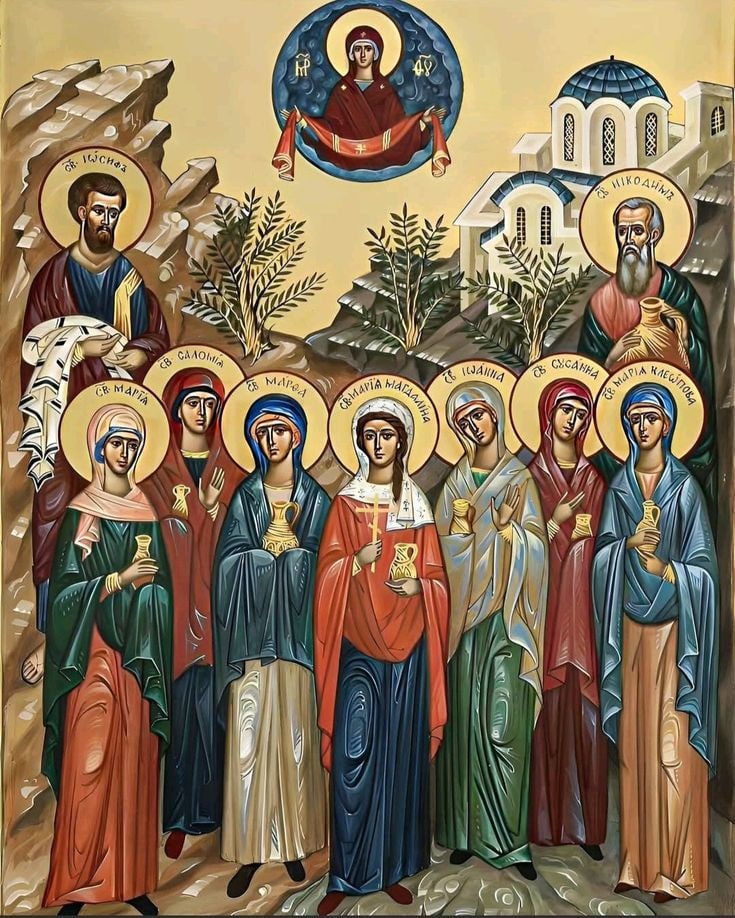
On the Third Sunday of Pascha, we commemorate the Myrrh-Bearing women. Yet it would not be entirely accurate to say that today we commemorate only the women. The Gospel also gives us two men, without whom the very burial of Christ would not have taken place: Joseph of Arimathea and Nicodemus.
These two are, in many ways, the most unexpected figures. Both were disciples of Christ, but in secret. The Gospel tells us that Joseph was a disciple “secretly, for fear of the Jews” (John 19:38). Nicodemus, we are told, first came to Christ “by night” (John 19:39). These are not the bold apostles we might expect, but cautious, hidden followers.
And yet, at the very moment when the visible disciples had fled, when almost all had disappeared, these hidden disciples step forward.
Joseph was a man of important standing, a member of the Sanhedrin, the very council that condemned Christ. In the Gospel according to St Luke though, we learn, that Joseph had not agreed with their decision (Luke 23:50-51). Already this was a risk: to dissent when Christ was condemned as a political threat – “King of the Jews” – a title seen as opposing Caesar.
But now he does something greater. He goes openly to Pilate and asks for the Body of Christ. No longer a secret disciple, he publicly identifies himself with the Crucified. He then gives the tombs, which he prepared for himself, for the burial of the Lord.
Nicodemus, for his part, brings a large quantity of spices – myrrh and aloes – in great abundance. Together, these two men take down the Body from the Cross, anoint it, wrap it in linen, and lay it in the tomb.
What were they thinking at that moment? Perhaps, nothing dramatic. Perhaps, they were simply doing what had to be done. They were fulfilling the proper burial, acting with a sense of duty. Or, even more deeply, they acted out of love. A quiet, faithful love that does not argue or hesitate, but simply serves.
The first lesson we receive from the story of Christ’s burial is the boldness of Joseph and Nicodemus. Not loud, not proclaimed, but real. When others withdrew, they stepped forward. In silence, they became central figures in the events of that Friday.
But then a question arises: why did the myrrh-bearing women go to the tomb on the first day of the week? We are told that they prepared spices and ointments and came very early in the morning (Luke 23:56; 24:1). Some say that the burial on Friday had been rushed because of the approaching Sabbath, and that the women went to complete what had been left unfinished.
There may be some truth in this. But the Gospel according to St John presents the burial as careful and abundant (John 19:38-42). The Body of our Lord had already been anointed, properly wrapped, and the entrance to the tomb was sealed with the large stone.
It appears there was no strict practical necessity for the women to go. So, it means, they went for another reason. They went out of love!
Love is not always reasonable. It does not ask whether something is necessary. For example, we give flowers to those we love. Why? Not because they are needed, or because one can draw some material benefit from them. We give because love expresses itself in giving of beautiful things. The gesture itself becomes meaningful.
In the same way, the Myrrh-Bearers came to the tomb. They wanted to be near the Lord. They wanted to serve, to care, to make sure that everything had been done. We even hear their concern on the way, who will roll away the stone for us from the entrance of the tomb (Mark 16:3). They did not have a solution. Yet they still had gone, and precisely there, in this act of faithful love, they became the first witnesses of the Resurrection.
There is something deeply human in this. That feeling that perhaps others have not done enough or not done it quite right: “Let me go myself.” It is the concern of love, which does not measure but gives.
Myrrh-Bearers come, not knowing how they will roll away the stone, not knowing what they will find. They only know that they must go. And precisely there, in this act of faithful love, they become the first witnesses of the Resurrection.
We see here two expressions of faithfulness and love. The quiet courage of Joseph of Arimathea and Nicodemus, who step forward when it is dangerous, and the persistent love of the Myrrh-Bearers, who come even when it seems unnecessary and, certainly, dangerous.
Both examples teach us that true discipleship is not only in words or in understanding, but in love that acts, even when it does not fully understand why or how, and even when it faces danger.
Both are needed. Both lead to Christ. Both are remembered by the Church.
Amen. Christ is Risen!
News and Announcements
- Faith & Fellowship Meeting this Wednesday, 29th April, 7:00 PM – Join us on Zoom this Wednesday. We will pray Little Compline and have spiritual conversation. Link: https://ucl.zoom.us/j/93643306643.
- Have you visited our Parish Library yet? Our library offers a growing collection of Orthodox books for adults and children: spiritual classics, lives of the saints, theology, Church history, and books for young readers. A good spiritual book can deepen our understanding of the faith and accompany us in our spiritual life.
You can browse the catalogue and request books online through the parish website. All the information about borrowing books, together with the online request form, can be found here: https://saintignatiusbelfast.org/library
Our librarians, Michael and Porphyrios, will be happy to help if you are looking for something to read. You can contact them at: library@saintignatiusbelfast.org