Dear brothers and sisters,
This is newsletter #34 of the St Ignatius Parish in Belfast.
Contents of this Newsletter:
- This Week in the Life of the Church: Spiritual Life and Prayer
- A Pastoral Word: What St Gregory Palamas Teaches Us About Our Spiritual Life
- News and Announcements: Reader’s Service at the Church this coming Sunday
This Week in the Life of the Church
At St George’s Cathedral in London, Metropolitan Silouan has blessed a series of talks on the spiritual life, which are being offered by the clergy during weekday services. Each week during Lent, we will share a new video from this series here for your spiritual benefit and encouragement.
Here you can find the recording of the first talk delivered by Fr Michel Touma, titled “Building the Spiritual Life through Prayer.” The talk is given in both Arabic and English, so you will not miss any of the content: https://www.youtube.com/watch?v=H_syDibXc8o
Saints and Feasts of the Week
*The saints named here accompany the days of the week as living witnesses of Christ. Only the principal saint or feast of each day is listed here, in keeping with the liturgical order of the Church.
- Sunday, 8th of March – Sunday of St Gregory Palamas
- Monday, 9th of March – Holy Forty Martyrs of Sebaste
- Tuesday, 10th of March – Quadratus the Martyr & his Companions
- Wednesday, 11th of March – St. Sophronius, patriarch of Jerusalem
- Thursday, 12th of March – St. Gregory Dialogos, pope of Rome & Apostle of the English
- Friday, 13th of March – Translation of the relics of St. Nicephorus, patriarch of Constantinople
- Saturday, 14th of March – St. Benedict of Nursia
- Sunday, 15th of March: Sunday of the Holy Cross
Hymns of the Week
*The hymns listed here are those that shape the prayer of the Church for the week, following the liturgical order and hierarchy. They are offered as an aid to prayer and may be used, as each is able, in personal prayer or a simple prayer rule at home.
RESURRECTIONAL APOLYTIKION IN TONE SIX
When Mary stood at Thy grave, looking for Thy sacred body, angelic powers shone above Thy revered tomb; and the soldiers who were to keep guard became as dead men. Thou led Hades captive and wast not tempted thereby. Thou didst meet the Virgin and didst give life to the world, O Thou, Who art risen from the dead, O Lord, glory to Thee.
APOLYTIKION OF ST GREGORY PALAMAS IN TONE EIGHT
O Star of Orthodoxy, support of the Church and its teacher, O comeliness of ascetics, and incontestable champion of those who speak in theology, Gregory the wonder-worker, the pride of Thessalonica and preacher of grace, implore thou constantly for the salvation of our souls.
KONTAKION FOR SUNDAYS IN GREAT LENT (AND AKATHIST SATURDAY)
To thee, the Champion Leader, do I offer thanks of victory, O Theotokos, thou who hast delivered me from terror; but as thou that hast that power invincible, O Theotokos, thou alone can set me free: from all forms of danger free me and deliver me, that I may cry unto thee: Hail, O Bride without Bridegroom.
Sunday Epistle and Gospel
*The Epistle and Gospel of the Sunday that begins the current liturgical week
- Epistle: Hebrew 1:10-2:3
- Gospel: Mark 2:1-12
The Sunday and daily Scripture readings may be read online via the Archdiocesan website: https://www.antiochian-orthodox.com/calendar
A Pastoral Word: What St Gregory Palamas Teaches Us About Our Spiritual Life
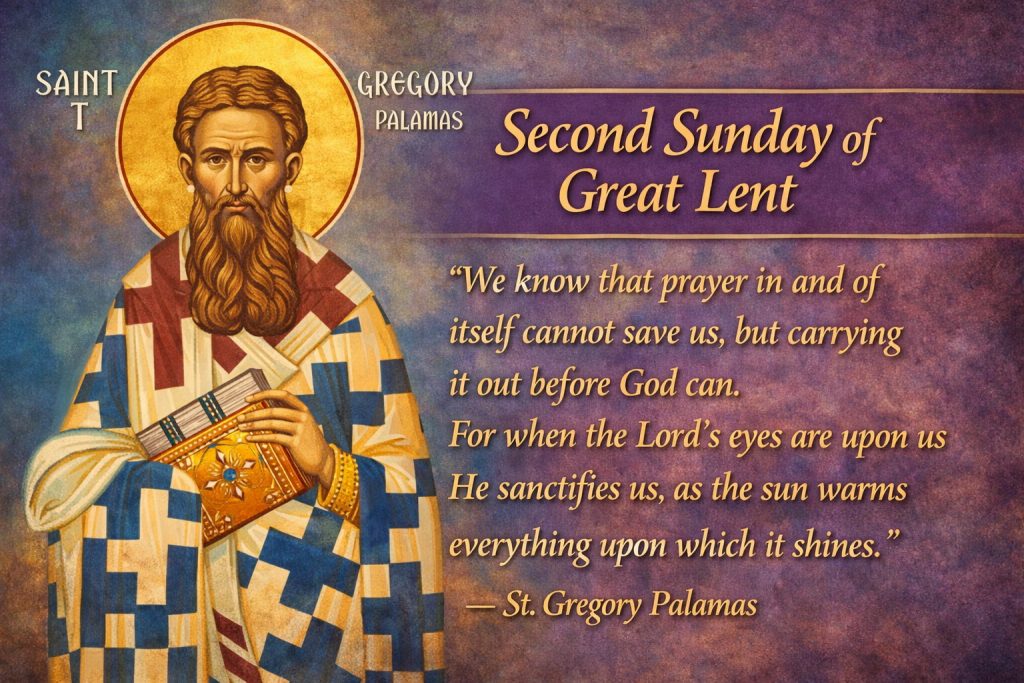
Last Sunday, the Second Sunday of Great Lent, is dedicated to St Gregory Palamas (1296–1359), Archbishop of Thessaloniki. St Gregory is especially known for his defence of Hesychasm, the Orthodox tradition of inner stillness and prayer of the heart. In this tradition, the Jesus Prayer is often used to bring the mind into the heart and to direct the whole human person, mind, heart and body, toward communion with God. Certain physical practices, such as attentive breathing and bodily stillness, may also be used as aids to concentration in prayer.
St Gregory defended this spiritual tradition against the criticisms of Barlaam of Calabria, who questioned the Hesychast teaching that human beings can truly experience God through prayer. Their disagreement led to what is known as the Hesychast controversy, which troubled the Orthodox Church in the fourteenth century.
But why does the Church remind us of St Gregory Palamas during Great Lent? What relevance does this theological teaching have for our spiritual life?
What was at stake in the Hesychast controversy was not simply a particular method of prayer. Prayer itself is not the ultimate goal. it is the means that leads us to the goal, which is the knowledge and experience of God. The deeper question was this: how can human beings know and experience God, if God is beyond all human understanding, as the Holy Fathers of the Church have always taught? As St Gregory the Theologian writes: “It is impossible to express God, and yet more impossible to conceive Him” (Oration 28).
At stake, therefore, was nothing less than the very meaning of our salvation. In the Orthodox Church, salvation is understood as theosis, or deification: the calling of the human person to become God-like, to be united with God and to participate in His life and holiness through His grace.
St Gregory built on the teaching of the Cappadocian Fathers, especially St Basil the Great, who wrote:“We know our God from His energies, but we do not claim that we can approach His essence. His energies come down to us, but His essence remains beyond our reach” (Letter 234).
The essence of God remains forever incomprehensible and beyond all created understanding. Yet God truly reveals Himself to us through His divine energies. These energies are not created effects or mere attributes of God. They are God Himself as He acts and reveals Himself to the world. In the life of the Church we usually refer to these divine energies as the grace of God.
One of the most well-known manifestations of these divine energies is the uncreated Light that shone from Christ during the Transfiguration on Mount Tabor (Matthew 17:1–2; Mark 9:2–3; Luke 9:28–29). St Gregory Palamas defended the teaching that this light is not a created phenomenon, but the uncreated light of God Himself: “This Light was the Light of the Divine Nature, and as such, it was Uncreated and Divine” (Sermon on Transfiguration)
The Hesychasts taught that through prayer, purification, and God’s grace, a person may experience this Divine and Uncreated light. Such an experience is not merely symbolic. It is truly an encounter with God, made possible through the transformation of the whole human person.
What St Gregory defended, therefore, was nothing less than the very foundation of our faith and the purpose of our life: that human beings are called to see God and to live in communion with Him. This transformation involves the entire human person, body and soul together. Through prayer, fasting, and participation in the sacraments, our whole nature is gradually healed and united to God.
Yet this union would not have been complete unless God Himself humbled Himself and became man for our sake. As St Paul writes, Christ “emptied Himself” (Philippians 2:7) and took on human nature. Through Christ, those who believe in Him and unite themselves to Him can participate in the life of God. St Gregory Palamas writes that this was God’s plan from the beginning: “The original creation of man in the image of God was for the sake of Christ, so that man might one day make room for the Archetype” (Homily 7).
At the end of Lent we celebrate the fulfilment of our salvation in Pascha (Easter), the passage from death to life, accomplished by Christ for our sake. As the Gospel says, “whoever believes in Him should not perish but have eternal life” (John 3:16).
Through the remembrance of St Gregory Palamas during Great Lent, the Church reminds us of the great purpose for which we were created: to know God, and to live in communion with Him.
This gives meaning to our fasting, our prayers, and our presence in church. They are not empty rituals, but the path that leads us closer to God.
If we truly wish to see God, the path is before us: pray, fast when the Church calls us to fast, and remain in the life of the Church through participation in her sacraments.
News and Announcements:
- Readers Service in Church on Sunday of Holy Cross, 15th of March, 11:00 am – Please join us at the church for the monthly Readers service of Hours and Typika (without priest) on Sunday, 15th of March. Come to pray together, to hear the Word of God and to have fellowship afterwards. Address: Cullen Memorial Hall, Methodist Complex, 381 Donegall Road, Belfast, BT12 6GR
- Online Faith & Fellowship – During Great Lent meetings take place every Thursday at 19:00, unless announced otherwise. Join us at 19:00 this Thursday, 12th of March, for the next meeting: https://ucl.zoom.us/j/93643306643 We will pray Great Compline and have a conversation about spiritual life.
- Have you visited our Parish Library yet? Our library offers a growing collection of Orthodox books for adults and children: spiritual classics, lives of the saints, theology, Church history, and books for young readers. A good spiritual book can deepen our understanding of the faith and accompany us in our spiritual life.
You can browse the catalogue and request books online through the parish website. All the information about borrowing books, together with the online request form, can be found here: https://saintignatiusbelfast.org/library
Our librarians, Michael and Porphyrios, will be happy to help if you are looking for something to read. You can contact them at: library@saintignatiusbelfast.org